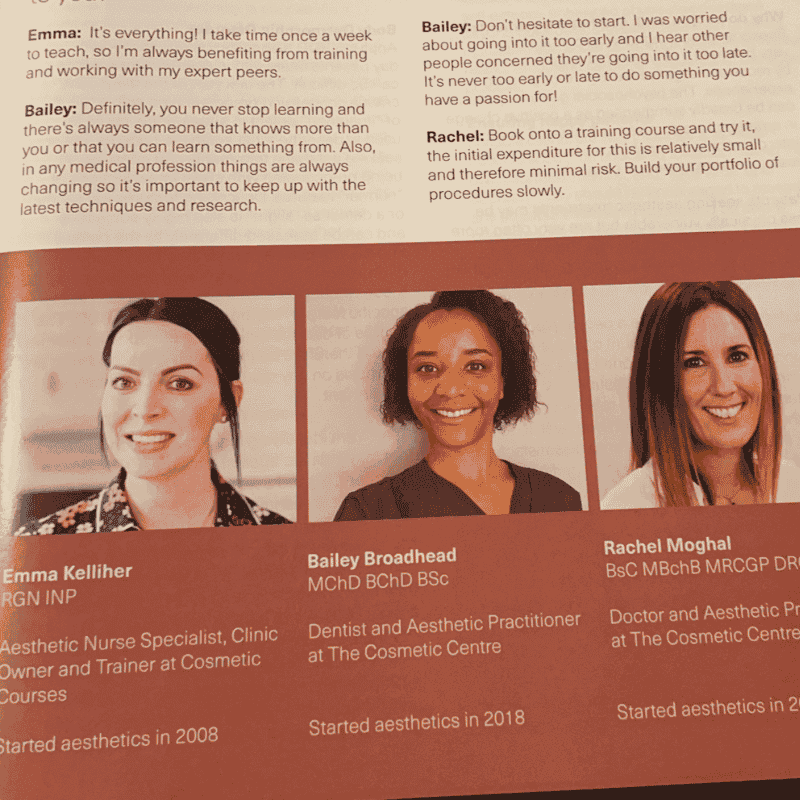
Dr. Bailey began her aesthetics career in 2018 with a Foundation course at Cosmetic Courses. Since then, her training has never really stopped.
What began as an additional area of clinical practice alongside her work as a dentist has developed into a career as an experienced aesthetics practitioner and clinical trainer. Along the way, Dr Bailey has continued to build on her knowledge of facial anatomy, injectable treatments, patient assessment and clinical safety.
She holds the VTCT (ITEC) Level 7 Diploma in Clinical Aesthetic Injectable Treatments, an advanced qualification that reflects both her clinical competence and her long-standing commitment to continued professional development.
Her progression from foundation training to Level 7 shows that this was more than advice for other practitioners. It has guided the way she has developed her own aesthetics career.
From Dentistry to Medical Aesthetics
Before entering medical aesthetics, Dr. Bailey qualified and worked as a dentist.

Dentistry provides a strong clinical foundation for facial aesthetics. Dentists develop a detailed understanding of the anatomy of the face, mouth, jaw, head and neck. They are also trained to assess patients medically, work precisely, manage clinical risk and follow strict standards of hygiene and professional accountability.
However, being a dentist does not automatically provide all the specialist knowledge required to perform injectable treatments.
Aesthetics involves additional considerations, including facial proportions, movement, the ageing process, product selection, injection techniques and the management of possible complications. Dr Bailey therefore undertook dedicated aesthetics training before offering these procedures to patients.
Starting Out as an Aesthetic Practitioner
Dr. Bailey discussed the early stages of her aesthetics career in Starting Out, an Injector’s Journey, an article created by Cosmetic Courses for Spark by Allergan Aesthetics.
In the article, she explained that she completed her Foundation course in 2018 and gradually built a client base through word of mouth. Becoming a skilled practitioner is not simply a matter of completing one course and immediately opening a clinic. It takes time to develop practical experience and clinical judgement. Practitioners must also invest in appropriate education, insurance, products, equipment and professional support.
Reflecting on the process, Dr Bailey described the hard work and financial investment involved, particularly during the early stages of building a practice.
Her advice to anyone following a similar path was:
“Don’t be afraid to invest in yourself!”
That commitment to investing in her own development has continued throughout her career.
Why Continuous Learning Matters in Aesthetics
Medical aesthetics continues to develop.
New products enter the market, existing techniques are refined and clinical research improves our understanding of facial anatomy, ageing and treatment safety. Professional guidance, patient expectations and approaches to complications management also change over time.
This means that the knowledge gained during an initial training course cannot be treated as the end of a practitioner’s education.
Continued professional development allows practitioners to revisit their existing techniques, consider new evidence and identify areas where their knowledge can be strengthened. It can also improve their ability to assess patients properly and make sound clinical decisions.
For Dr. Bailey, continued learning has never been about collecting certificates for display.
The purpose is to become a more knowledgeable and capable practitioner, make better treatment decisions and provide patients with a high standard of care.
It also means recognising that no practitioner knows everything. Remaining open to further education, peer discussion and new research helps prevent complacency in a field where clinical decisions can have a significant effect on patient safety and treatment outcomes.
Progressing from Student to Clinical Trainer
As Dr. Bailey’s own experience developed, she progressed from attending training courses to helping educate other medical professionals.
As a clinical trainer with Cosmetic Courses, she has supported doctors, dentists and nurses as they develop their knowledge and practical skills in injectable treatments.
Teaching brings its own responsibilities.
A trainer must be able to explain facial anatomy, assessment and treatment techniques clearly. They must also observe how other practitioners work, identify areas for improvement and provide constructive clinical guidance.
Teaching does not mean that a practitioner’s own learning has finished. In many cases, it has the opposite effect.
Working alongside other practitioners creates regular opportunities to discuss different approaches, review clinical decisions and remain engaged with changes in the profession. It requires the trainer to understand not only how to perform a procedure, but why a particular approach is appropriate.
Dr. Bailey’s work as a trainer therefore forms another important part of her own continued professional development.
Dr. Bailey’s Level 7 Aesthetics Qualification
Dr Bailey holds the VTCT (ITEC) Level 7 Diploma in Clinical Aesthetic Injectable Treatments, completed through Cosmetic Courses.

It is an Ofqual-regulated qualification within the UK Regulated Qualifications Framework.
Level 7 represents an advanced level of study; it requires practitioners to demonstrate detailed theoretical knowledge and practical clinical competence.
The qualification goes considerably further than learning how to inject a particular product into a particular area.
It considers the complete treatment process, including consultation, patient selection, facial assessment, treatment planning, practical delivery, aftercare and the management of potential complications.
What Does Level 7 Aesthetics Training Incorporate?
The qualification examines several areas that are fundamental to safe, ethical and effective aesthetic practice.
Advanced facial anatomy
Detailed anatomical knowledge is essential when performing injectable treatments.
Practitioners need to understand the muscles, nerves, arteries, veins, fat compartments and underlying structures of the face. They must also recognise that anatomy can vary between patients.
This knowledge informs decisions about where a product may be placed, how deeply it should be administered and which structures need to be avoided.
Dr. Bailey’s dental background provided an established understanding of facial anatomy. Her aesthetics training and Level 7 studies have allowed her to develop this knowledge further within the context of injectable procedures.
Consultation and patient assessment
An aesthetics consultation should involve more than asking a patient which treatment they would like.
A practitioner must consider the person’s medical history, current medication, previous treatments, concerns, expectations and reasons for seeking a procedure. They must also identify any contraindications that could make treatment unsuitable.
A thorough assessment helps the practitioner determine whether the requested procedure is likely to produce an appropriate result.
Sometimes the most suitable recommendation may be different from the treatment a patient originally had in mind. On other occasions, the right decision may be to postpone treatment or advise against it altogether.
Facial assessment and treatment planning
Injectable treatments should not follow the same template for every patient.
Facial proportions, bone structure, muscle movement, skin quality and the distribution of facial volume vary considerably between individuals. These differences must be considered when creating a treatment plan.
Advanced training encourages practitioners to assess the face holistically, rather than looking at one feature in isolation.
For example, a patient may initially enquire about treating one line or adding volume to one area. However, a full assessment may reveal that another approach would produce a more balanced and natural-looking result.
The objective is not to follow a trend or recreate another person’s features. It is to recommend treatment that remains appropriate for the individual patient.
Product knowledge
Practitioners need to understand the products they use, including how they work and how their properties can affect the treatment result.
Different injectable products are designed for different purposes. Their formulation, consistency, behaviour within the tissue and expected longevity may vary.
Product selection should therefore be based on the patient’s anatomy, the area being treated and the clinical objective. It should not be determined solely by which product is currently popular.
Advanced product knowledge helps practitioners select an appropriate treatment while explaining its likely benefits, limitations and potential risks clearly to the patient.
Practical clinical competence
Level 7 is not based on theory alone.
Practitioners are required to demonstrate their practical abilities and clinical decision-making. This includes conducting consultations, assessing patients, creating treatment plans and delivering injectable treatments safely.
Competency-based assessment is important because knowing information in theory is not the same as applying it appropriately in a clinical setting.
The practitioner must be able to adjust their approach to the individual patient rather than relying on a memorised injection pattern.
Risk reduction and complications management
No injectable procedure is entirely free from risk.
Even when a treatment is performed by a medically qualified and experienced practitioner, side effects and complications remain possible. Patients should be given honest information about these risks before deciding whether to proceed.
Advanced aesthetics training examines how practitioners can reduce avoidable risks, recognise the signs of a developing problem and respond appropriately if an adverse event occurs.
This includes understanding when urgent action or onward medical referral may be required.
A Level 7 qualification cannot guarantee that a complication will never occur. What it does demonstrate is that risk assessment, complications recognition and appropriate clinical management have formed part of the practitioner’s advanced training.
Ethics and professional responsibility
Being technically capable of performing a treatment does not necessarily mean that the treatment should go ahead.
Aesthetic practitioners have a responsibility to manage expectations, provide balanced information and avoid recommending unnecessary procedures.
They must also ensure that patients understand the limitations of treatment and have sufficient time and information to make an informed decision.
Ethical practice may sometimes involve saying no.
This could be because the requested treatment is unlikely to achieve the desired result, the patient is medically unsuitable or the practitioner believes the procedure would not be in their best interests.
Why Choose a Practitioner with Level 7 Training?
The level of training and experience found across the aesthetics sector varies considerably.
For patients, this can make comparing practitioners difficult. A large social media following, attractive clinic or extensive gallery of photographs does not necessarily demonstrate advanced anatomical knowledge or clinical competence.
Qualifications are therefore an important consideration, but they should not be viewed in isolation.
Patients should also consider:
- The practitioner’s original medical, dental or nursing qualification
- Their professional registration
- Their aesthetics focused education
- Their practical experience
- Their approach to consultation and consent
- Their knowledge of potential complications
- The aftercare and support they provide
- Their commitment to continued professional development
Dr. Bailey’s Level 7 Diploma adds to her existing background as a dentist, experienced aesthetic practitioner and clinical trainer.
It provides formal recognition of her advanced knowledge and practical competence, while demonstrating that her approach to learning has continued well beyond her initial foundation course.
What Does This Mean for Patients at Dr .Bailey Medspa?
For patients, advanced training should be reflected in the quality of the complete treatment experience.
This begins with a proper consultation rather than a rushed appointment or automatic agreement to perform the treatment requested.
At Dr. Bailey Medspa, each patient is assessed individually. Their concerns, medical history, facial anatomy and desired outcome are considered before suitable options are discussed.
The consultation also provides an opportunity to explain what treatment can realistically achieve, what it cannot change and which risks need to be considered.
This considered approach supports treatment plans that are personalised rather than prescriptive.
It also reflects the principles that have guided Dr Bailey’s professional journey: invest in education, remain open to learning and place patient welfare at the centre of clinical decision-making.
Medical Aesthetics Treatments in Leeds
Dr. Bailey Medspa is based within Roots of Respect in the Leeds University Quarter.
The clinic provides personalised medical aesthetics treatments, including anti-wrinkle injections, dermal fillers, lip enhancement, Profhilo, HArmonyCa and non-surgical facial rejuvenation.
Dr. Bailey’s journey from Foundation training to an advanced Level 7 qualification demonstrates that becoming an experienced practitioner does not mean there is nothing left to learn.
In a medical field that continues to develop, continued education remains an essential part of providing informed, ethical and safe patient care.
To discuss your concerns and find out which options may be suitable for you, book a consultation with Dr. Bailey in Leeds.